

chain link fence: an all-around expert in industrial and civilian protection
2025-11-18 09:53:44
Click:
“
chain link fence, a metal woven mesh marked by a diamond grid, has become a core
”
chain link fence, a metal woven mesh marked by a diamond grid, has become a core material in modern engineering protection, agricultural breeding, sports facilities and other fields due to its unique craftsmanship and excellent performance. From the anti-collision guardrails on highways to the fence systems on football fields, from the reinforcement projects of mine slopes to the green plant supports on family balconies, the hook and loop net interprets the infinite possibilities of metal materials with its characteristics of 'flexibility, impact resistance, corrosion resistance, and durability'.

1、 Parameter analysis: Accurately match scene requirements
The specification parameters of the hook and loop net directly affect its functional positioning, and the core indicators include wire diameter, mesh size, mesh size, and surface treatment process:
Wire diameter selection: The wire diameter range covers 1.2mm to 6mm, and the larger the diameter, the stronger the impact resistance. For example, the stadium fence needs to use a wire diameter of 3mm or more to resist ball impacts; The green plant frame on the family balcony can balance load-bearing and lightweight by using a 2mm wire diameter.
Mesh: Mesh sizes range from 25mm x 25mm to 100mm x 100mm. In the breeding scene, a 10cm × 10cm mesh can prevent young birds from escaping; The slope protection project adopts large mesh holes of 15cm × 15cm or more to ensure stable stone filling.
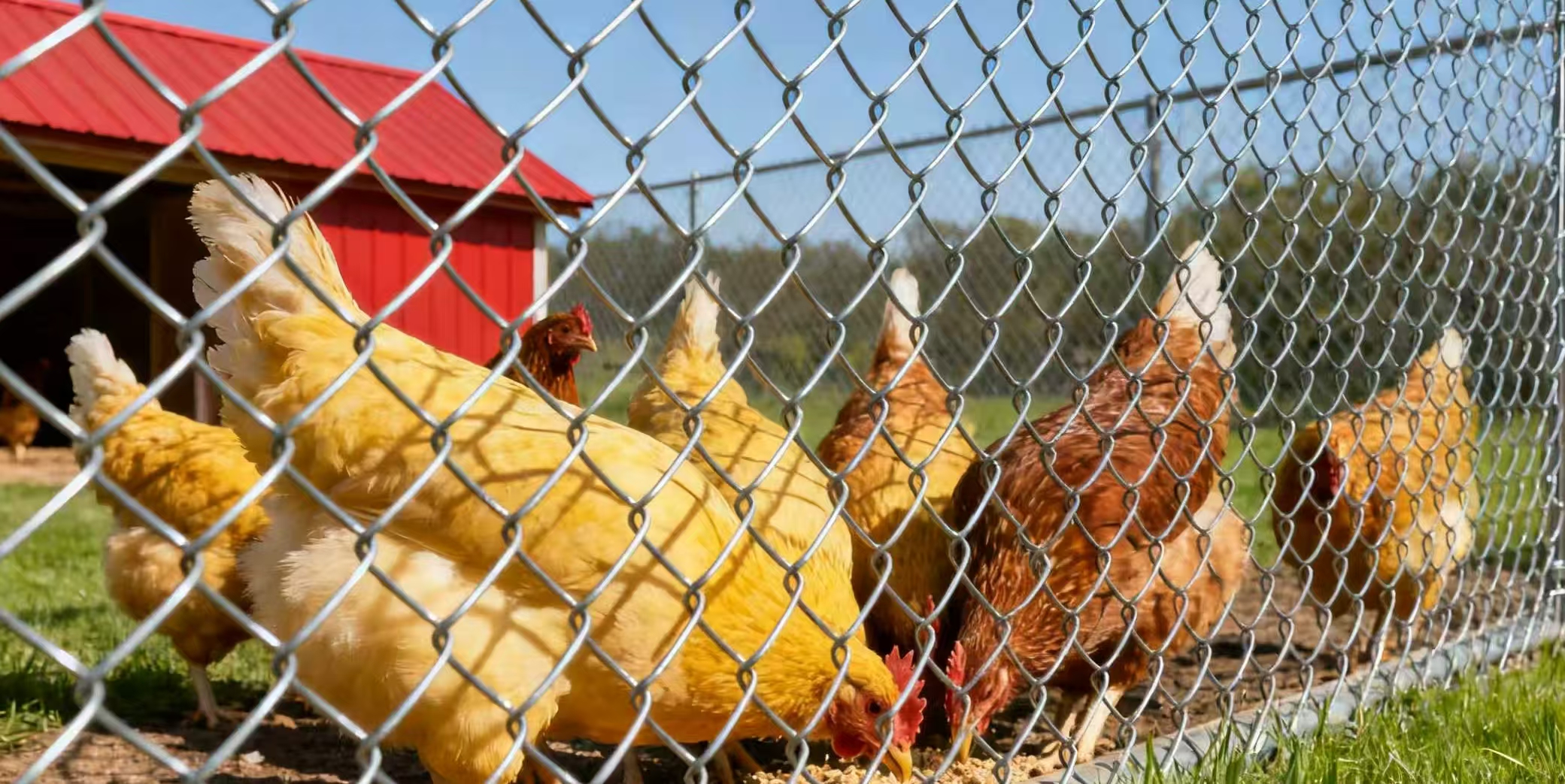
Mesh customization: The standard mesh width can reach 3 meters, and the length can be infinitely extended. The maximum single piece mesh can reach 3000mm × 4000mm. A mining support project once customized a 6-meter wide hooked mesh, which achieved kilometer level slope coverage through modular splicing.
Anti corrosion treatment: The thickness of the hot-dip galvanized layer is over 80 μ m, which can resist salt spray corrosion; The thickness of the PVC coating layer is 0.5mm, which combines rust prevention and aesthetics. Experimental data shows that hot-dip galvanized wire mesh has a service life of over 15 years in humid environments, while PVC coated products can still remain colorfast for 5 years under UV irradiation.
2、 Material evolution: from basic protection to high-end applications
The material selection of the hook net directly determines its performance boundary, and the three mainstream materials form differentiated application scenarios:
Low carbon steel wire: With significant cost advantages, it is suitable for temporary protective engineering. A construction site uses 2mm cold galvanized steel wire mesh, which reduces the cost per square meter by 40% compared to hot-dip galvanized wire mesh, but needs to be replaced every 2 years.

Stainless steel wire: Models such as 304 and 316 stainless steel wire have extremely strong corrosion resistance and have become the preferred choice for marine engineering. A certain seawall reinforcement project uses 316 stainless steel hook mesh, which has been continuously used for 20 years without corrosion in seawater erosion environment.
Aluminum alloy wire: with a density only one-third that of steel, yet maintaining the same strength. A certain plateau railway project adopts aluminum alloy hook mesh, which reduces weight while achieving -40 ℃ low-temperature anti brittle fracture through special oxidation treatment.
3、 Technological breakthrough: from mechanical weaving to intelligent manufacturing
The core process of crochet net - crochet technology, has formed two mature systems after a hundred years of iteration:
Folding and shrinking process: By mechanical bending, a double-layer wire structure is formed, and the tear resistance strength of the mesh surface is increased by 30%. The fence of a certain automobile testing site adopts this technology and successfully resists the impact of vehicles traveling at a speed of 120km/h without deformation.
Twisting edge locking process: adopting a spiral locking structure to eliminate stress concentration at weaving nodes. Experiments have shown that the hooked mesh produced by this process has a lifespan 50% longer than traditional processes in repeated tensile tests.
The introduction of intelligent manufacturing technology further promotes the upgrading of the accuracy of hooked mesh. A manufacturer in Hebei has introduced an AI visual inspection system that can monitor mesh size deviations in real time, increasing the product qualification rate from 92% to 99.7%. At the same time, 3D weaving technology enables the one-time molding of complex curved mesh bodies, and a curved fence project for an art venue has shortened the installation cycle by 60% through this technology.
4、 Scenario application: From industrial protection to ecological governance
The application boundaries of hook and loop networks continue to expand, forming five core areas:
Safety protection: The highway guardrail adopts a 5mm wire diameter, 50mm × 50mm mesh size, and is equipped with 75mm steel pipe columns, which can withstand the impact of 2-ton vehicles.
Ecological governance: Stone cage cages filled with crushed stones are used for river slope protection projects. The treatment project of a tributary of the Yangtze River uses hooked mesh stone cages to provide growth space for aquatic plants while resisting flood erosion.
Agricultural breeding: A certain intelligent chicken farm adopts a framed hooked net, and through the linkage of an automated feeding system and the net body, the inventory of a single chicken house exceeds 100000 feathers.
Sports facilities: The football field fence system integrates shock-absorbing spring devices, which can absorb 30% of the impact energy. The fence of a certain professional league stadium has been tested to be able to block football at a speed of 80km/h without rebounding into the audience.
Technological innovation: The designer combines hook and loop with LED lighting to create an interactive architectural curtain wall with variable patterns. The exterior wall of a commercial complex in Shanghai adopts this design, presenting dynamic light and shadow effects at night, becoming a popular check-in spot for internet celebrities.
5、 Future Trend: Integration of Materials Science and Digital Technology
With the breakthrough of new materials and intelligent technology, the hooked net is evolving towards the direction of 'lightweight, intelligent, and functional':
Nano coating technology: A self-healing anti-corrosion coating has been developed in the laboratory stage, which can automatically fill microcracks and extend its service life to 30 years.
IoT integration: A safety monitoring system for a certain mine embeds sensors in the hook and loop network nodes to monitor real-time stress changes in the network and warn of landslide risks.
Biobased materials: Plant fiber-reinforced composite crochet mesh under development, achieving 100% biodegradability while maintaining strength, providing a new solution for ecological restoration.
The evolution history of hooked mesh from simple protective nets during the Industrial Revolution to multifunctional materials in the intelligent era is a microcosm of human material science innovation. With the advancement of the 'dual carbon' target, this traditional metal product is revitalizing through technological innovation, continuing to write new legends in fields such as safety protection and ecological construction.
Author:
Anping County Zeming Wire Mesh Products Co









Prev : Introduction to Dutch mesh Products
Next : chain link fence Manufacturer - chain link fence Introduction
a metal woven mesh marked by a diamond grid
YouArticle
已有0人推荐
Contact Us
 Houzhangzhuang Village, Anping County, Hengshui City, Hebei Province, China
 sales01@hbzmwiremesh.com sales02@hbzmwiremesh.com sales03@hbzmwiremesh.com
 +86 19831801907 18631872677 18631875581
About Us
Anping County Zeming Wire Mesh Products Co., Ltd., founded in 2011, is a professional manufacturer and exporter of wire mesh fencing products, located in Anping County, Hengshui City, Hebei Province, the famous “Wire Mesh Production Base” in China.
Products
Protection Fence
Chain-Link Fence
Temporary Fence
Metal Fence Panel
Razor Barbed Wire
Gabion Mesh
Copyright © 2005-2015 MySite Ltd. All Rights Reserved.